The Gornergrat Bahn, explained
I sold this ticket several thousand times from the window at the Zermatt station, four winters and three summers of it, and almost every difficult conversation I had there was about money rather than mountains. People arrive holding a pass they think covers the ride, or a return they did not need, or a seat on the wrong side of the carriage. Here is what the line is, what it should cost you, and where to sit.
A railway that has been climbing since 1898
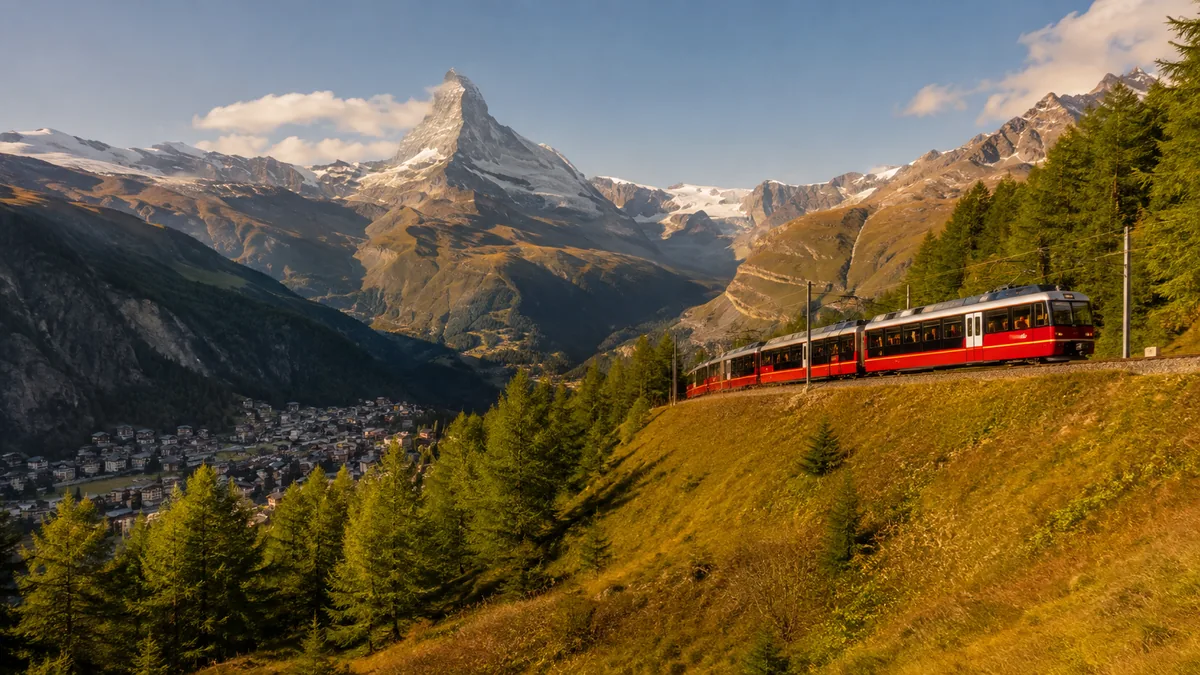
The Gornergrat Bahn opened on 20 August 1898 as the first electric cogwheel railway in Switzerland, and it still runs on the Abt rack system with something like 155,000 cogs under it. The track is metre gauge and 9.339 km long, of which 3.790 km is double. Some 97.3% of it sits on a gradient, steepest at 20%, through 1,364 m of tunnels and galleries and over five bridges totalling 127 m — the Findelbach bridge alone accounts for 90 m of that. The terminus was pushed 71 m higher to its present 3,089 m in 1909 and the station was rebuilt in 2004. The operator, Gornergrat Bahn AG, part of the BVZ Group, calls it the highest open-air rack railway in Europe, and moves about 2,400 people an hour up it in season. We are not the railway; we just explain its tariff.
The money, stated plainly
The adult summer return is CHF 132, which makes it one of the most expensive mountain-railway tickets in Switzerland, and most people should not be paying it. A Swiss Travel Pass, a Half-Fare Card, a Swiss Half Fare Card, a GA or an Adventure Card each takes exactly 50% off, turning CHF 132 into CHF 66. None of them makes the ride free. That single misunderstanding is the one I corrected more than any other, usually to a face that had already budgeted the money elsewhere.
Then there is the season. From November to April the same return is CHF 102, and children travel free up to their 9th birthday instead of their 6th, which quietly changes what a family day costs. Groups of ten or more get 20%. Buying online requires a passport or personal ID, and — this matters — there is no cheaper online price. Booking ahead buys you the queue, not a discount, and anyone telling you otherwise is selling something. The full table, both seasons and every station, is on ticket prices, and the pass rules sit on discounts.
The best seat on the train is free
Going up, the Matterhorn is on the right-hand side, and near Zermatt the rear-facing seats hold it longest. That is a matter of standing on the correct part of the platform rather than paying anybody. Priority Boarding costs CHF 7 in the Zermatt → Gornergrat direction and buys exactly one thing: boarding three minutes before everyone else, then free choice of any seat. It is not a seat reservation, it does not guarantee the right-hand side, and the priority waiting area closes 10 minutes before departure, which is how people who paid for it end up boarding last. Accompanied children under 6 get it free. More on where to sit.
What 3,089 metres actually feels like
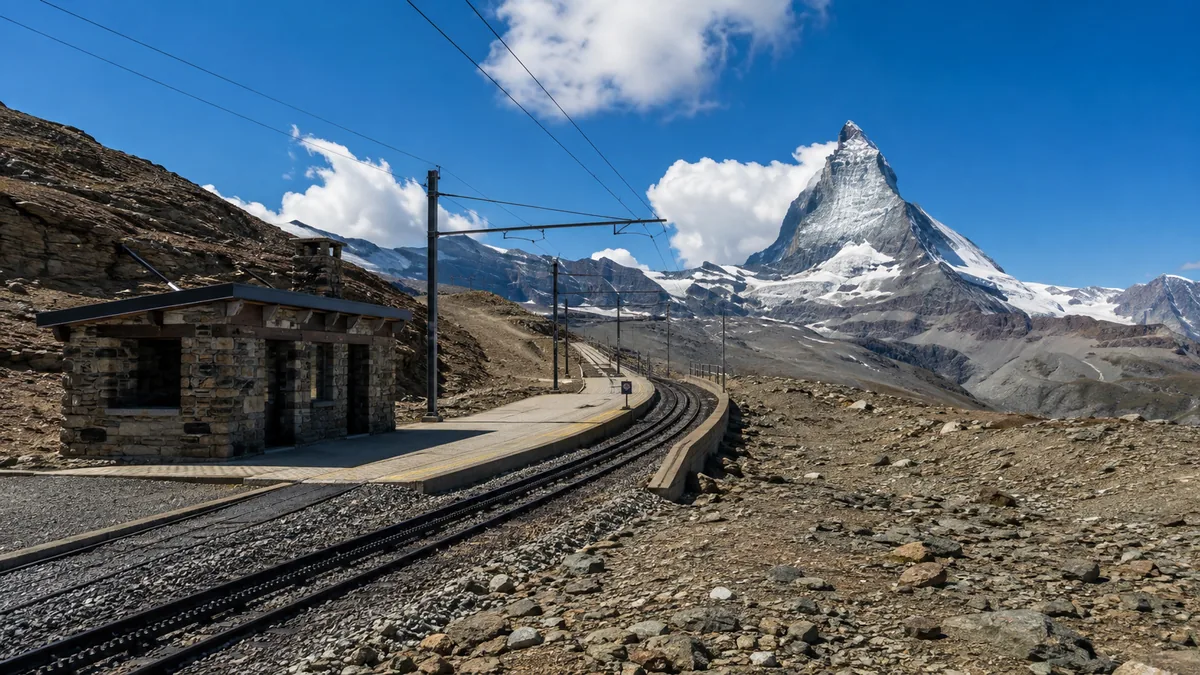
The summit is roughly 1,500 m above the village and significantly colder, whatever the thermometer said when you left Zermatt. Mild altitude effects are possible from about 2,000 m upward; the fix is to move slowly and sit down, and to take more care with children under 2, pregnant travellers and anyone in poor health. What you get for the climb is 29 peaks over 4,000 m and roughly seven glaciers, including the Gorner Glacier, about 12.9 km long and the third-longest in the Alps, with Monte Rosa’s Dufourspitze at 4,634 m — the highest point in Switzerland — above it. ZOOOM the Matterhorn, the three-stage exhibition with the periscopes, the 3D cinema and the paragliding simulator, is open daily 09:45–16:15 and is included in both Gornergrat tickets we list. The Golden Spot, built around the restored gold-plated 1898-generation locomotive He 2/2 3003, costs nothing at all. Above the 3100 Kulmhotel, the highest hotel in the Swiss Alps, two observatory towers stand at 3,120 m, the south one holding the Stellarium Gornergrat and its 600 mm telescope. What to do up there.
The walk down is the part most people should buy
You do not have to buy a return, and if you can walk downhill for an hour you probably should not. The trail from Rotenboden to Riffelberg runs 3.1 km and takes about an hour, graded easy to moderate, past the Riffelsee and a second, smaller lake and on to the Brother Klaus chapel, whose outline copies the Weisshorn. The Matterhorn reflects in the Riffelsee on windless mornings and at dusk, best in July and August. The Alpine Garden at Rotenboden covers over 5,000 m² at 2,800 m, and its rare flowers bloom in July and August only. From 20 June to 12 September 2026, about 125 Valais Blacknose sheep graze near it between 10:00 and 16:00, free to visit, best before 12:30. The operator sells a hiking ticket for exactly this day out at CHF 108 adult and CHF 54 reduced: up to the summit, walk, train down from Riffelberg. See the hiking ticket and, if you are still weighing the whole thing up, whether it is worth it.
One date to avoid: the line is closed from 2 to 14 November 2026 for construction work, and the fortnight after it runs every 48 minutes rather than every 24.
Ready to book?
Dates first, then the ticket. If you are still choosing between the railway and the cable car, read how the two mountains compare; if you want the fare table in full, it is on the prices page.
Frequently asked questions
How long does the Gornergrat Bahn take?
Thirty-three minutes up and forty-four minutes down, with departures every 24 minutes from 08:00 in the main season. The full pattern, including the 2–14 November 2026 closure, is on the timetable page.
How much is a Gornergrat ticket in 2026?
A summer return from Zermatt is CHF 132 and the winter return is CHF 102. A Swiss Travel Pass, Half-Fare Card, GA or Adventure Card takes exactly half off, which is the single biggest saving available — see which passes qualify and the full fare table.
Which side of the train should I sit on?
The right-hand side going up from Zermatt. It is free, it is not something Priority Boarding guarantees, and it is the difference between watching the Matterhorn for half an hour and watching a rock wall — the detail is on where to sit.